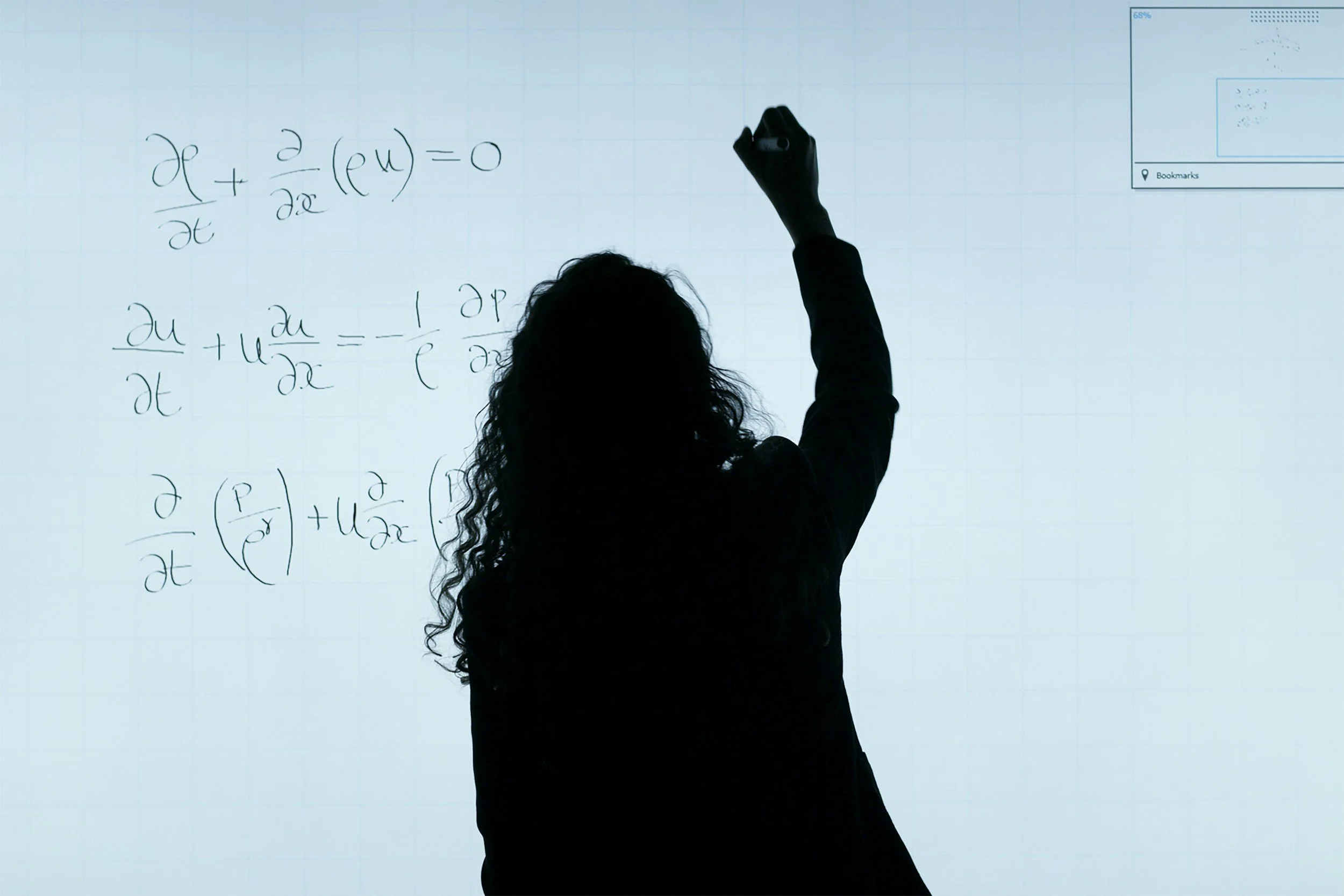
Communicating Mathematics
Mathematics is the language of the universe — but whose voice gets to speak it?
Writing and communicating your thoughts is a skill you will need in just about any career you pursue — including a career in a mathematical field. Mathematics has long been celebrated as the language of the universe. As a subject, we love its elegance, permanence, and ubiquity.
Through language — symbols, writing, talk — we strive to communicate its beauty and its relevance to a variety of audiences. The purpose of this course is to develop your reasoning, writing, and presentation skills in the context of mathematics, as well as to help you find your own voice in this field of study.
An important objective of any mathematician is to learn to deliver their message and professional and personal insights in a way that makes sense to its intended audience. This course will run as a team-based learning class which will help you learn to work as partners.
To be an effective communicator, we will hone our skills in three dimensions: message (content), presenter (speaker/writer), and audience (reader/listener).
This course asks: Who gets to be a mathematician? How does mathematics participate in structures of power and belonging — and how can our voices reshape that?
Communicate mathematical ideas with clarity, coherence, and logical rigor — from concise proofs to extended expository writing — while engaging audiences effectively.
Adapt mathematical writing for diverse audiences — including peers, general readers, and scholarly communities — demonstrating control of genre, tone, and purpose.
Examine the cultural and historical context of mathematics, recognizing how practices are shaped by societal traditions and exploring pathways to broaden inclusion and access.
Reflect on the role of mathematics in society and in your own intellectual journey, articulating connections among mathematics, identity, and ways of knowing.
Engage in collaborative research and presentations, effectively communicating mathematical inquiry in written and spoken forms.
Foster curiosity and wonder through mathematical storytelling and creative strategies that make abstract concepts comprehensible and compelling.
Collaborate ethically and constructively, participating in peer review, co-authorship, and discussions that enrich mathematical understanding and writing practices.
Assignments span individual and collaborative work — from short reflective papers and proof exercises to large collaborative projects. You will write in LaTeX, record audio, design for multiple audiences, and lead your peers in discussion.
Each major assignment builds a different communication muscle: writing for general audiences, professional mathematical exposition, and multimedia storytelling. Short papers (best 5 of ~8) give you low-stakes space to experiment and develop your voice.
Write a 5–7 page piece for a broad public audience — a magazine article, blog post, or similar genre — on a mathematical topic of your choosing. The goal is to inform while engaging: accessible language, accurate mathematics, and a compelling narrative.
Choose your path: expose and prove a nontrivial theorem with rigor and clarity; write a polished textbook section with examples and exercises; or partner with a community organization for a mathematical learning experience and reflective write-up.
Create a video series of 2–4 short episodes exploring a mathematical topic for an educated general audience. Each group member takes on a production role — writer, on-camera host, videographer, producer, or editor — and contributes substantively to research, scripting, filming, and editing.
Subject to modification as the semester progresses. Check course platform for updated deadlines.
| Week | Theme | Topics & Activities | Assignments Due |
|---|---|---|---|
| Week 1 | Finding Your Mathematical Voice | Course intro · community agreements · math narrative · LaTeX basics · proof structure · library orientation | Short Response to "What is Mathematics?" · Proof Writing #1 Draft |
| Week 2 | Tools of the Trade: Proofs & LaTeX | Style, tone & audience · Discussion sign-up · peer review of Proof #1 · managing group dynamics | Short Proof Writing #1 Final · Personal Narrative Draft · Select Expository Topic |
| Week 3 | Who Gets to Be a Mathematician? | Math identity & personal voice · Discussion Leading begins · public communication strategies · intro video series assignment | Short Math Personal Statement · Expository Paper Outline |
| Week 4 | Building Arguments & Explanations | Peer review of expository outlines · Discussion Leading · proof workshop · LaTeX advanced formatting | Short Proof Writing Part II · Continue Expository Paper |
| Week 5 | Math Stories for the World | Audience & clarity in public writing · finalize expository projects · Discussion Leading · library sources session | Major Expository Paper Final Submission |
| Week 6 | Researching & Writing Mathematics | Research writing basics · analyzing math paper structure · Discussion Leading · LaTeX citations & figures · journal databases | Short Response to Reading · Major Project 2 Proposal |
| Week 7 | The Language of Professionals & Video Series Workshop 1 | Professional communication · Discussion Leading · Resumes & cover letters · Beamer workshop · Video Series Workshop 1 | Short Resume or Cover Letter · Beamer Draft · Video series group & topic proposal |
| Week 8 | Teaching the World a Theorem | Short Beamer Presentations · Discussion Leading · visual clarity in exposition · effective diagram use | Project 2 Outline |
| Week 9 | Storytelling with Mathematics | Discussion Leading · storytelling in mathematics · dedicated project time · video series storytelling workshop | Short Response to Reading · Project 2 Draft · Video series script/talking points |
| Week 10 | Production Technology & Collaborative Writing | Discussion Leading · Video Series Workshop 2: Audacity & WeVideo · co-authoring strategies | Major Project 2 Final Submission |
| Week 11 | Video Series Production & Practice | Discussion Leading · dedicated recording & editing time · peer feedback | Short Response to Reading · Optional: 1-min video trailer |
| Week 12 | Video Series Editing & Refinement | Discussion Leading · continued recording & editing · peer review · revision workshop | Continue video series production |
| Week 13 | Curating Your Mathematical Legacy | Discussion Leading · portfolio assembly · Video Series Workshop 3 (open lab) · video series finalization | Short Reflection · Major Video Series Final Upload |
| Week 14 | Video Series Screening & Presentations | In-class video screening & presentations · celebration of work · portfolio prep for Art Show | Portfolio preparation |
| Finals | Celebration & Reflection | Art Show — present selected portfolio work in artistic format to peers and guests | Major Art Show |
While you will receive a final grade at the end of the term, this is an ungraded course. Grades will be determined by you and your instructor together at the end of the semester.
You will be asked to self-assess your learning in relation to content, skill development, and growth as an individual. Your grade is a product of your overall effort and demonstrated growth. We will meet individually to discuss your self-reflection at both midterm and the final period.
If assignments fall below a certain professional level, you will be asked to revise and resubmit — because growth, not performance, is the point.
A selection of work produced by students in MTH 305 — expository papers, Beamer presentations, and video series episodes — alongside reflections on the experience of learning to communicate mathematics.
I came in thinking mathematical writing meant proofs. By week five I had written something my grandmother could actually read — and that felt more rigorous in its own way.
The collaborative paper forced us to agree on every word. That kind of negotiation taught me more about mathematical precision than any problem set.
Making the video series made me realize how much I had to actually understand something to explain it on camera. You can't hide behind notation when you're looking straight at the lens.